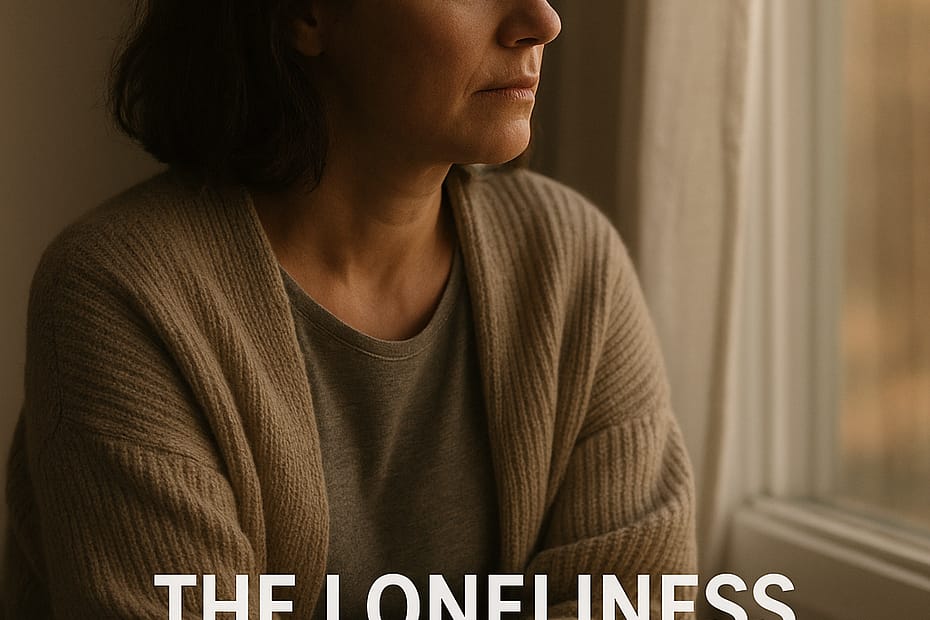
“Grief isn’t just about missing someone — it’s about learning to live with the silence they leave behind.”
No one prepares you for the quiet after loss. People warn you about the tears, the paperwork, and the milestones you’ll face alone — but not the silence. The loneliness of widowhood has a way of creeping in even when you think you’re doing okay. It’s in the empty chair at dinner, the quiet house at night, the way you still look for their keys on the counter.
Even surrounded by people, the ache doesn’t go away. You can smile, laugh, and still feel utterly alone inside.
The Shock of Silence
In the early days, the loneliness feels almost physical — like a heavy fog that settles over everything. You reach for someone who isn’t there, listen for footsteps that never come, and realize the world has gone on without you.
There’s a strange kind of disorientation that happens when you lose your person. The sounds of the house are different. The rhythm of your day is off. Even the light feels unfamiliar.
And the hardest part is that you never know when the loneliness will hit. Sometimes it’s in the quiet of morning, sometimes in the middle of a crowded room.
Loneliness in a Room Full of People
What surprised me most was how lonely I felt even when I wasn’t alone. My family has a lot of get-togethers — birthdays, dinners, holidays — and I found myself standing in a room full of people who love me, but feeling completely disconnected.
It wasn’t that they weren’t kind. They were. It’s just that I didn’t know how to talk to them anymore. I didn’t have anything to say that made sense. Small talk felt impossible when my whole world had fallen apart.
I think maybe part of it was depression, but mostly it was emptiness. I didn’t care about much of anything. I couldn’t pretend to be interested in normal life when I felt like mine had ended.
And later, when everyone else went home, that’s when the silence came back even stronger — especially at night.
3 A.M. — When the World Is Silent Too
Sleep became a struggle. I could fall asleep easily enough, but staying asleep was another story. I’d wake up around 3 a.m. every single night, eyes wide open in the dark, staring at the ceiling and feeling that deep, aching loneliness that only exists in those hours when the world is completely still.
There’s something about those moments that makes everything hit harder — the missing, the silence, the realization that your person isn’t coming back. You can’t turn over and talk to them, can’t share the small thoughts that used to make the night feel less empty.
Those are the moments that truly test you.

Losing Your Best Friend
People talk about losing their spouse, but for many of us, we also lost our best friend. The one who knew every version of us — the silly, the serious, the tired, the brave. The one who could make you laugh in the middle of an argument or talk you down when life got messy.
That’s what makes widowhood such a deep kind of loneliness. You didn’t just lose your partner. You lost the one person who understood you without words.
It’s impossible not to feel lonely after that kind of loss. It’s impossible not to ache when every memory still holds both love and absence.
Why Widowhood Feels So Isolating
Even when you start getting back into routines, something feels missing. You’re doing the things you used to do — the grocery store runs, the chores, the family visits — but everything feels off balance.
And people mean well, they really do. But often, they move on much sooner than you do. After the first few months, the calls slow down, the invitations fade, and you’re left trying to rebuild your world quietly, without much help.
That’s why the loneliness of widowhood isn’t just about being alone — it’s about feeling unseen.
Small Ways to Cope with Widowhood Loneliness
Healing from this kind of loneliness doesn’t happen quickly. There’s no “fix.” But there are small things that can help you carry it a little easier:
- Allow the silence to exist. You don’t have to fill every quiet moment. Sometimes the quiet is where healing starts. Sit with it when you can. Cry if you need to.
- Reach out, even in small ways. It doesn’t have to be big. A short text, an online widow support group, even a comment on another widow’s post — just something that reminds you you’re not the only one walking through this.
- Create small routines of comfort. Light a candle before bed, take a morning walk, or journal about your day. Tiny rituals can give your days a sense of structure when everything else feels uncertain.
- Talk to your person. Say their name, speak to them out loud, write them letters. It’s okay to keep that connection alive. Love doesn’t disappear just because life changed.
- Seek support when you’re ready. A therapist, counselor, or online grief group can help you process emotions that feel too heavy to carry alone.
You don’t have to be strong every day. You just have to keep breathing through the hard ones.
Finding Peace in the Quiet
With time, the loneliness softens. It never completely disappears — but it becomes something you can live with.
You start to find moments of peace in the same silence that once felt unbearable. You start to fill the quiet with new things: memories, purpose, maybe even joy.
You don’t stop missing your person. But you begin to learn how to live with the missing.
And one day, without realizing it, you wake up and notice that the world feels a little lighter. The silence isn’t so loud. You can breathe again — not because you’ve stopped grieving, but because you’ve learned to carry it with you.
A Final Thought
If you’re reading this and feeling that deep, aching loneliness — please know it doesn’t mean you’re broken. It means you loved deeply. It means you’re human.
The loneliness of widowhood is proof of how big your love was. And while life will never look the same again, it can still hold meaning, connection, and hope — one small, quiet moment at a time. 💛
Related Posts You Might Like
If this post resonated with you, here are a few thoughtful Amazon finds you might also love:
- Gratitude or reflection journal
- Soft throw blanket for cozy evenings
- Simple self-care candle or diffuser
As an Amazon Associate, I earn from qualifying purchases.