
Disclosure: This post may contain affiliate links. As an associate, I earn from qualifying purchases. This means I may receive a small commission if you choose to make a purchase through one of my links, at no extra cost to you. I only share items that genuinely bring comfort, calm, or creativity.
When my husband died, I thought I understood what grief would feel like — sadness, tears, emptiness. What I didn’t expect was the anxiety.
It hit me like waves I couldn’t see coming. One moment I’d be doing something ordinary — driving, folding laundry, feeding the dogs — and then suddenly my heart would start pounding. My chest would tighten. It felt like I couldn’t breathe.
The first time it happened, I was driving and a song came on the radio — our song. Without warning, the sound of it sent my body into full-on panic. I pulled over, hands shaking, realizing that grief isn’t just emotional. It’s physical. It lives in your body and sometimes it screams.
These sudden waves of emotion can feel like they come from nowhere. When Grief Hits You Out of Nowhere shares ways to steady yourself in those moments.
⸻
Why Grief Feels Like Anxiety
Losing someone you love sends your mind and body into survival mode. Your nervous system doesn’t know the difference between emotional danger and physical danger. It just knows you’re not safe.
That’s why grief can look and feel a lot like anxiety: racing thoughts, restlessness, tightness in the chest, that constant feeling of waiting for something bad to happen — even though the worst thing already has.
There’s a reason for it.
When we lose someone, our brains release stress hormones like cortisol and adrenaline. These chemicals were meant to protect us, but when you’re grieving, they linger — keeping your body on high alert even when there’s no threat around you.
You might find yourself flinching at sudden noises, feeling jumpy when your phone rings, or getting overwhelmed by simple tasks. It’s not “just in your head.” It’s grief talking through your body.
When grief-related anxiety starts to take over—racing thoughts, sleepless nights, or panic that comes out of nowhere—professional support can make a difference.
Online-therapy.com offers online therapy with licensed counselors who understand grief and trauma. You can message or meet by video without leaving home.
⸻
Recognizing the Signs of Grief Anxiety
Grief anxiety can show up in quiet ways — or loud ones.
You might:
• Feel your heart racing at night when you try to rest.
• Wake up with a pit in your stomach that won’t go away.
• Replay “what ifs” and “if onlys” on an endless loop.
• Feel like you can’t breathe in crowded places or during emotional moments.
• Avoid things that used to bring joy because they now bring uncertainty or fear.
I remember trying to tell myself, “You’re okay, just breathe.” But my body didn’t believe me yet. That’s the thing — your body needs time to catch up to what your mind already knows: that you survived something unimaginable.
And if anxiety is leaving you physically drained, When Grief Hurts: The Physical Ways Loss Affects the Body explores how emotional stress shows up in the body.
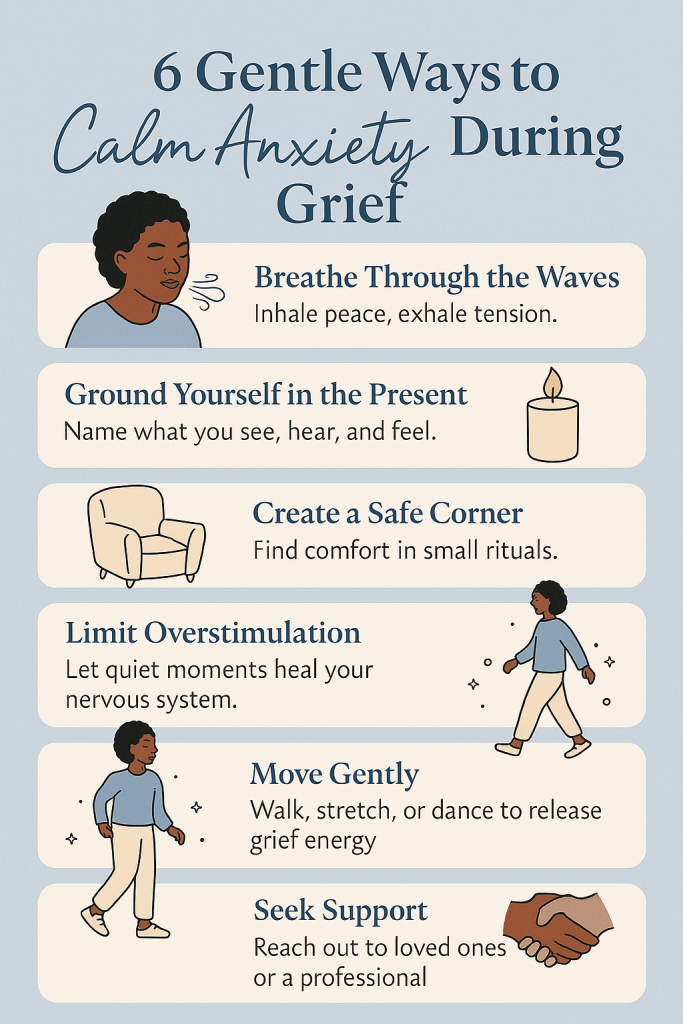
How to Calm Grief Anxiety (Gently)
I wish I could say there’s a quick fix, but healing after loss isn’t about erasing the anxiety — it’s about learning to move with it.
Here are a few things that helped me and might help you too:
- 🌿 1. Ground Yourself in the Present
When your mind spirals, focus on what’s real around you.
Feel your feet on the floor. Name five things you can see, four things you can touch, three things you can hear, two things you can smell, one thing you can taste. It sounds simple, but it brings you back from the storm in your head to the calm of the moment.
- 🕯️ 2. Create a Comfort Ritual
Light a candle. Make tea. Sit with your journal.
When I start feeling anxious, I reach for small rituals — the same mug, the same quiet corner — things that remind me I’m safe. Over time, these small acts became anchors when grief tried to pull me under.
- 🐾 3. Get Out into Nature (Even If It’s Just the Porch)
I’ve learned that healing sometimes begins with the simplest step — stepping outside.
The air, the trees, even watching my dogs explore reminds me that life keeps moving. Nature grounds you in something bigger than pain.
- 💭 4. Talk It Out — or Write It Out
Grief anxiety thrives in silence.
If you can, talk to a friend, a counselor, or someone who’s been through loss. And if words are too hard to say, write them down. I’ve poured countless thoughts into my journal — some too raw to share — but each one helped me release what I was holding inside.
- 🧘🏾♀️ 5. Breathe Through the Waves
I still have moments where I feel that tightness in my chest. When it happens, I stop and breathe slowly — in through the nose, out through the mouth — reminding myself: You’re safe now. You’re allowed to relax.
It doesn’t make the grief go away, but it makes it easier to carry.
- 💬 6. Know When to Ask for Help
There came a point when I realized that all the breathing exercises and journaling in the world weren’t enough. I was doing everything right — meditating, grounding, walking, writing — but my anxiety still felt like it was swallowing me whole.
That’s when I talked to my doctor and learned that sometimes grief and anxiety are too heavy to manage alone. Medication became one more tool in my healing toolbox — not a failure, not weakness, just help.
If you’ve tried everything and still feel stuck, please know it’s okay to reach out for professional help. Sometimes healing needs both heart work and medical support. Therapy, support groups, or medication don’t erase your strength — they support it. You can try online therapy here if you aren’t ready to try in person
Learning to Live in a Softer Way
Grief anxiety taught me something I didn’t expect — that strength isn’t about pretending to be fine. It’s about letting yourself feel the storm and still believing in the calm that follows.
These days, I still get anxious. I still miss him. But I also find peace in small moments — watching the sunrise, laughing with my daughters, or lighting a candle in his memory.
Healing doesn’t mean you’ll never feel pain again. It means you learn to hold your pain gently, without letting it control every breath.
So if your heart is racing and you can’t explain why, take a slow breath.
You’re not broken — you’re healing.
And it’s okay to take it one small, shaky breath at a time.
⸻
“Grief and anxiety both whisper the same thing: you’ve lost something precious. Healing whispers back: you’re still here, still breathing, still worthy of peace.”