Disclosure: This post may contain affiliate links. As an associate, I earn from qualifying purchases. This means I may receive a small commission if you choose to make a purchase through one of my links, at no extra cost to you. I only share items that genuinely bring comfort, calm, or creativity.
When I first lost my husband, people would ask me what stage of grief I was in. I knew what they meant: denial, anger, bargaining, depression, acceptance. The famous five stages. I wondered if I was “doing it right.” Was I supposed to march through them one by one until I was healed?
The truth is, the stages of grief can be a helpful way to name feelings. But they’re not a checklist. They don’t come in a straight line. And they don’t look the same for everyone.
The Five Stages of Grief (Quick Overview)
Elisabeth Kübler-Ross first introduced the five stages in her book On Death and Dying. Later, she and David Kessler applied them to grief in On Grief and Grieving. The stages are:
- Denial → “This can’t be real.”
- Anger → frustration at circumstances, others, or even yourself.
- Bargaining → “If only I had…” thinking.
- Depression → deep sadness, withdrawal, heaviness.
- Acceptance → not about being “over it,” but acknowledging the reality of loss.
These words can bring comfort because they give language to emotions that otherwise feel overwhelming. But grief is not a school assignment where you pass one level and move on to the next.
Why the Stages Don’t Always Fit
It’s important to know: the stages weren’t originally designed for people grieving a loss. They came from Kübler-Ross’s work with patients facing their own death. Over time, they were adapted into grief work.
For many people, the stages show up out of order. Or one lingers for months while another never shows up at all. You might feel acceptance one morning, only to find yourself back in anger by nightfall.
Think of it less like a ladder and more like a messy scribble — arrows pointing in all directions. Grief isn’t linear. It loops, circles back, and surprises you.
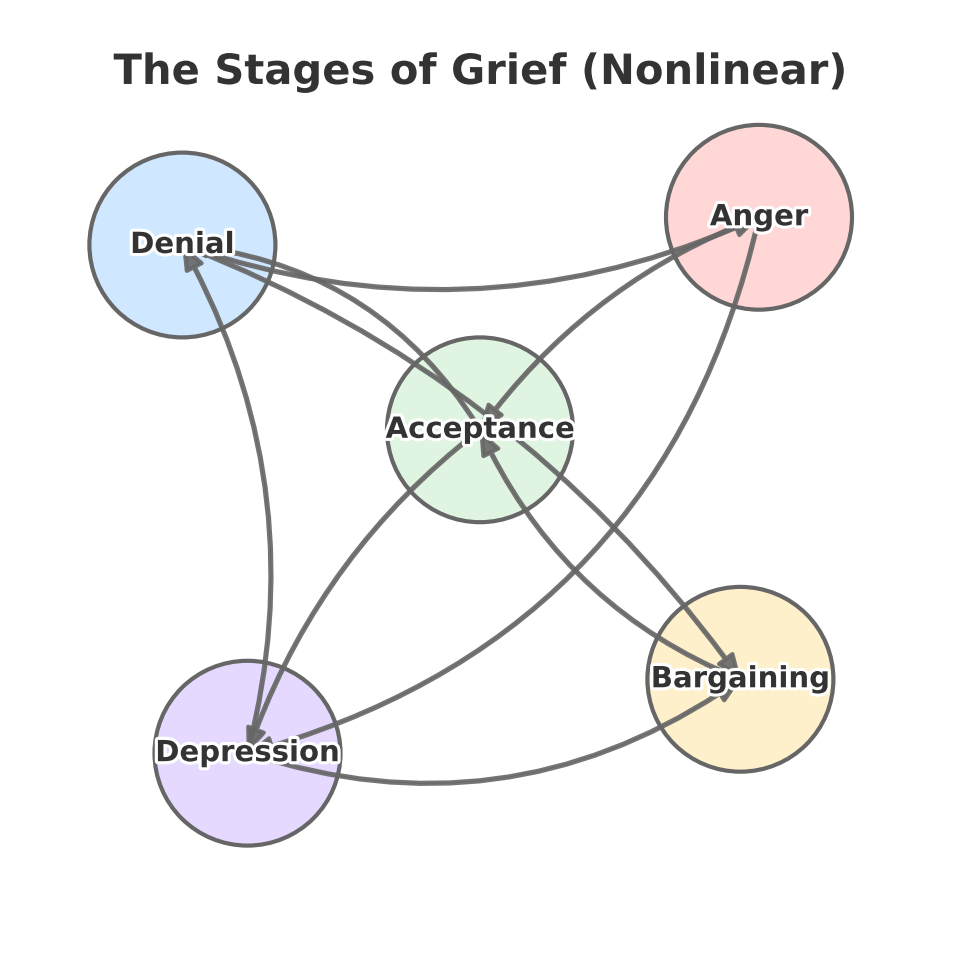
The stages of grief aren’t a straight path — they overlap, repeat, and shift.
Other Ways to Understand Grief
Researchers Margaret Stroebe and Henk Schut introduced what’s known as the dual process model, which suggests we move back and forth between loss-oriented grief (deep sadness, yearning) and restoration-oriented tasks (figuring out life without your loved one).
Some people find comfort in stages. Others resonate more with waves, spirals, or bursts of grief. There’s no wrong way to describe it.
My Experience with the Stages
For me, denial was one of the hardest. I tried to convince myself that he was just out and would be home soon. My brain couldn’t process the loss — or maybe it was my heart that refused to.
And then there was anger. I was mad at everyone. Mad at my husband for leaving me. I can’t count how many times I yelled, cried, and called him a stupid man for dying on me. Mad at life for being so cruel. Mad at the world for moving on while I was frozen in pain.
Bargaining never really showed up for me. I felt like me and God weren’t on speaking terms, so I had no one to bargain with.
Depression stayed for a long time. It intertwined with anxiety until I realized I needed extra support, and there was no shame in that. If you feel like you need some extra support you can try online therapy
Acceptance has been the slowest and softest stage. Not a finish line, but a gentle understanding that my love for him carries on, even in his absence.
Gentle Guidance for Readers
If you don’t feel like you’re moving through the stages “the right way,” you’re not failing. The stages are one lens, not a rulebook. Your grief is valid whether it fits these boxes or not.
Final Thoughts
The stages of grief can be useful, but they’re not a map. They’re just a language to help describe emotions. Your journey will be uniquely yours, with its own rhythm and shape.
And if you’d like to read more, Kübler-Ross and Kessler’s book On Grief and Grieving explores these ideas in depth and has helped many people find meaning in their loss.
— — — — — —
If you’re finding comfort here, you might enjoy more reflections and gentle grief support from Gentle Grief Support by Bonded by Art — a space for healing hearts to rest, reflect, and feel less alone.

Pingback: How Long Does Grief Last? – Gentle Grief Support from BondedbyArt
Pingback: How a Citrus Tree Helped Me Heal: Finding Comfort and Calm Through Plants After Loss – Gentle Grief Support from BondedbyArt